- System7 Newsletter
- Posts
- S7 | AI Weekly Pulse: Superintelligence, Robotics & Automated Media Frontier
S7 | AI Weekly Pulse: Superintelligence, Robotics & Automated Media Frontier
Dive into AI's cutting-edge frontier with S7 | The AI Pulse, exploring a fully AI-generated newsletter revealing groundbreaking insights into superintelligence and technology's future. 🚀🤖

Nicolas Baxter
August 26, 2025

Introduction
Welcome to the second edition of this fully AI-generated newsletter. Every story, summary, and insight you’re about to read has been chosen, compiled, written, and structured by AI.
This is an experiment. The goal? To push the limits of AI in content generation, refine the process, and see just how far we can take automation in curating and delivering the most relevant AI news.
Along the way, I’ll be tweaking, testing, and iterating - so expect updates, improvements, and perhaps a few surprises. Consider this a journey into the evolving role of AI in media. Let’s see how well it does and thanks for joining us!
Please note, AI can hallucinate! But we do our best to avoid that.
25/08/25 Foreword
“Hi everyone, thank you for subscribing to our newsletter and we look forward to you being part of the journey. Please do share your thoughts and feedback as we progress.
This week there are no tweaks or updates”. - Very best, Nicolas and the System7 team.
Now, onto the latest in AI.
Welcome to this week's AI roundup! The tech landscape is shifting rapidly as both established players and new entrants reshape how we interact with artificial intelligence. Meta reorganizes its superintelligence efforts, Google introduces practical AI features in everyday tools, and companies race to balance innovation with security concerns. Meanwhile, Chinese AI models are challenging Western dominance with impressive performance at lower costs. Let's dive into the developments that matter most.
Major AI News Headlines
Meta's AI leadership shake-up and superintelligence pursuit.
Real-world AI applications in Google's Pixel devices and documents.
The growing cost-performance battle between Chinese and Western AI models.
Major AI News
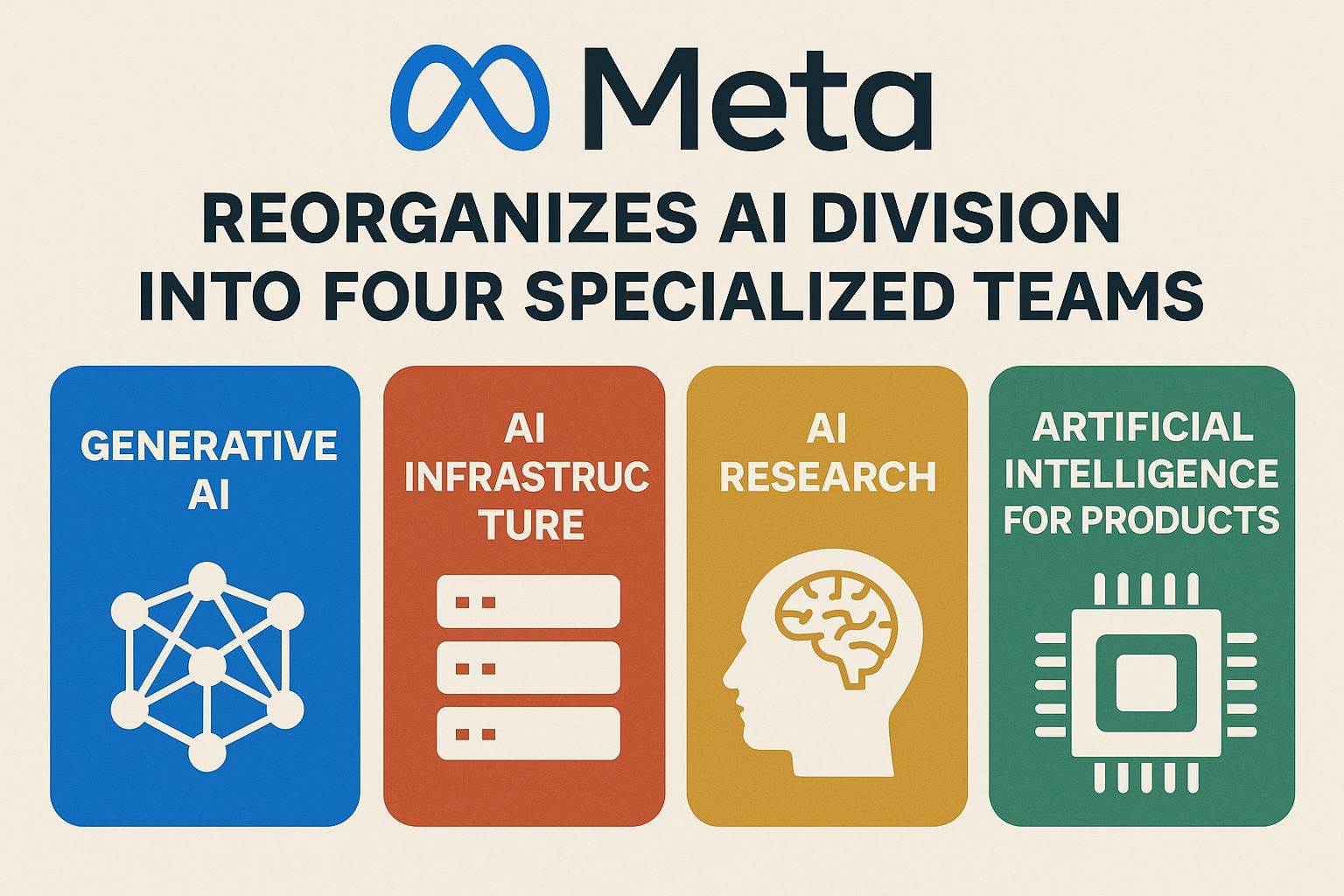
Meta reorganizes AI division into four specialized teams
Summary
Meta has restructured its AI operations under 'Meta Superintelligence Labs' with Scale AI co-founder Alexandr Wang taking central leadership. The four teams include a forward-looking TBD Lab, an AI products division, infrastructure support, and long-term research, with both Friedman and LeCun reporting to Wang.
Why It Matters
This consolidation shows Meta's serious commitment to AI despite a recent hiring pause. The company has invested heavily, including a 49% stake in Scale AI for $14.3B, and is integrating these resources while plotting its next moves in the superintelligence race against OpenAI and Anthropic.
Key Takeaway
Meta is streamlining leadership under Wang rather than using a co-leadership model, Despite a hiring pause, Meta continues aggressive AI investment with a clear focus on superintelligence, The restructuring suggests Meta is digesting recent acquisitions before its next phase of growth.
Source: Link
Chinese AI models offer impressive performance at fraction of GPT-5's cost
Summary
wo groundbreaking Chinese models are making waves: Z.ai's GLM 4.5 outperforms GPT-4.1 on coding benchmarks while costing 35 times less than GPT-5, and DeepSeek V3.1 integrates 'hybrid thinking' with costs as low as 9 times cheaper than GPT-5.
Why It Matters
These price-performance advantages could significantly alter the competitive landscape, though security concerns remain paramount for enterprise adoption. The models are designed for autonomous agents that can interact with systems and other AI, raising questions about proper risk management and trust.
Key Takeaway
Chinese models are achieving competitive or superior performance at drastically lower costs, Security and trust will be the ultimate moat for Western models despite price pressures, The shift toward agent-native, autonomous AI capabilities is accelerating globally.
Source: Link
Google embeds AI directly into everyday tools and services
Summary
Google has rolled out several practical AI implementations including Copilot AI in Excel for data analysis, AI-based text-to-speech in Google Docs, and enhanced search capabilities through 'agentic' features that can book reservations and collaborate on shared searches across 180+ countries.
Why It Matters
By focusing on practical applications within existing workflows, Google is making AI useful for everyday tasks rather than just as a standalone chatbot. This approach helps users adopt AI incrementally while demonstrating real productivity benefits.
Key Takeaway
Google is embedding AI capabilities directly into familiar tools rather than creating separate experiences, Practical applications like document summarization and data analysis show immediate value, AI features that complete tasks (booking, organizing) demonstrate the shift toward more autonomous capabilities.
Source: Link
Fun AI Topics Of The Week!
Duolingo's viral content strategy takes a hit amid AI implementation
Summary
After announcing an 'AI-first' strategy in April, Duolingo faced criticism over job security and app quality concerns, causing it to tone down its usually edgy social media presence. Despite slower user growth, the company reported strong financials with a 41% revenue jump and 84% profit increase.
Why It’s Interesting!
Duolingo's situation highlights the tension between maintaining a beloved brand voice and navigating the workforce implications of AI adoption. The stock still soared 19% after hours despite the social media pullback.
Key Takeaway
Even successful AI implementations can create PR challenges when job impacts are perceived, Companies may need to temporarily adjust their brand voice during major AI transitions.
Source: Link
AI-generated worlds become real-time experiences
Summary
Dynamics Lab's Mirage 2 creates real-time AI-generated environments that transform based on typed prompts, letting users instantly shift from a Wild West setting to an urban city. Despite having a small team, they've created dynamic, playable experiences including a walkable version of Van Gogh's Starry Night.
Why It’s Interesting!
This technology demonstrates 'autoregressive prediction' similar to unreleased systems like Google Genie 3, where AI can build interactive worlds from text descriptions in real-time, pushing the boundaries of creative applications.
Key Takeaway
Small teams can now create immersive AI experiences that previously required massive resources, The technology blurs the line between game design and prompt engineering.
Source: Link
AI video creation face-off: Sora vs. Midjourney
Summary
OpenAI's Sora and Midjourney now both offer short video generation capabilities with distinct approaches. Sora excels at quick, polished marketing or internal videos through a straightforward interface, while Midjourney creates moodier, stylized visuals better suited for creative or abstract pieces.
Why It’s Interesting!
The competition between these tools shows how rapidly AI video generation is evolving, with each platform finding different niches. Users can now create professional-quality video content without traditional production costs or licensing hassles.
Key Takeaway
AI video generation is becoming more accessible and practical for everyday users, Different tools are developing specializations rather than trying to be all-purpose solutions.
Source: Link
AI Tools Of The Moment
Automatically generates descriptive file names by analyzing document content, saving time on manual organization.
Acrobat Studio
Adobe's new PDF platform with 'PDF Spaces' that lets you chat with AI assistants about multiple documents at once.
Inworld Runtime
Auto-scales AI workloads from 10 to 10M users with built-in MLOps and one-click experiments.
Fiveonefour
Developer toolkit for building fast data backends for AI chats and dashboards.
Eleven Music API
Creates commercial-use music from text prompts with full licensing clearance.
Expert Prompt Of The Week
CONTEXT
With the rise of context engineering as a key skill for AI interactions, this prompt template from Anthropic's Prompting 101 resources helps create more precise, effective instructions.
PROMPT
I need help with [TASK]. Here's some context about me/my organization: [BACKGROUND]. I want you to write in a [TONE] tone. When completing this task, follow these rules: [RULES]. Here are some examples of what I'm looking for: [EXAMPLES]. Our previous conversation included: [HISTORY]. Right now, I need you to [SPECIFIC_REQUEST]. Think step by step to ensure accuracy. Format your response as [FORMAT]. To get started, here's a partial response: [PREFILLED_RESPONSE].
EXAMPLE USE CASE
This structured approach helps when creating complex business documents, analyzing data, or generating creative content. By providing comprehensive context upfront, you'll get more relevant results with fewer back-and-forth exchanges. For instance, when analyzing quarterly sales data, you could specify your role, company background, preferred analytical approach, and exact metrics to focus on.
Trending AI Topics For The Week

OpenAI planning encrypted conversations in ChatGPT
Summary
Sam Altman announced plans to add encryption to ChatGPT, starting with temporary chats, citing the sensitive nature of many conversations. OpenAI also seeks legal privileges similar to doctor-patient confidentiality for AI interactions.
Why It’s Important
As AI assistants handle increasingly sensitive information, privacy protections become critical for user trust and regulatory compliance. However, balancing privacy with AI training needs remains a significant challenge.
Google study claims 90% of game developers now use AI
Summary
A recent Google Cloud study reports that nine out of ten game developers rely on AI tools to streamline production, from code optimization to content processing and audio/video editing.
Why It’s Important
As game development costs rise and competition intensifies, AI adoption has become essential for studios to remain competitive by automating routine tasks and focusing more resources on creative aspects.
MIT study finds 95% of corporate AI pilots fail to generate revenue
Summary
Only 5% of generative AI pilots in large enterprises quickly generate revenue, while startups succeed by focusing on specific pain points and forming smart partnerships. Poor workflow integration and misaligned budgets are the main obstacles.
Why It’s Important
This highlights the implementation gap between AI potential and practical business results. Companies that buy specialized AI tools rather than building in-house and empower managers to drive changes see better outcomes.